What is a yes or no wheel, and how does it work?
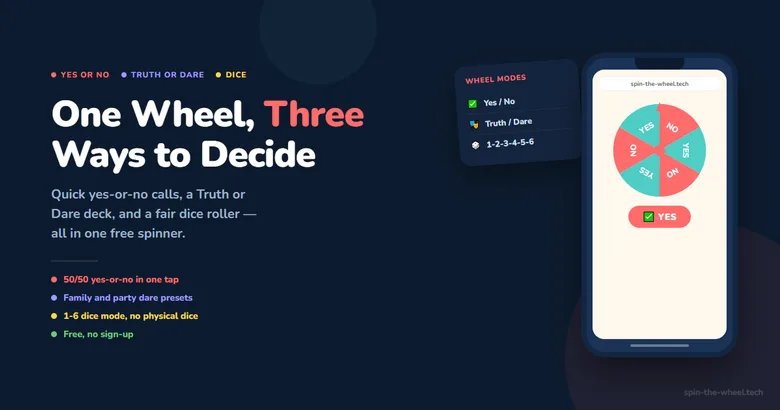
A yes or no wheel is a spinner loaded with exactly two entries, "Yes" and "No," so one tap gives a random 50/50 call instead of you agonizing over it. Type both words into Spin the Wheel, hit spin, and the built-in cryptographic randomness picks one instantly, the same underlying crypto.getRandomValues() standard used in browser security.
In 2007, Cornell researchers Brian Wansink and Jeffery Sobal found that the average adult makes more than 200 food-related decisions a day alone, yet guesses the true number at just 14.4 (Wansink & Sobal, Environment and Behavior, 2007). Stack that against what to wear, what to watch, and whether to text back, and handing a low-stakes yes-or-no call to a wheel isn't laziness. It's decision-fatigue triage.
📌 Key Takeaways
- People underestimate how many small decisions they make daily, real vs guessed by roughly 15x (Wansink & Sobal, 2007).
- A two-entry Yes/No wheel gives a true, cryptographically random 50/50 call in one tap.
- A University of Chicago study of over 20,000 people found those told by a coin toss to make a change reported being happier months later (Levitt, NBER Working Paper No. 22487, 2016).
- The same wheel doubles as a Truth or Dare spinner and a 1-6 dice roller, no extra app needed.
Does letting a wheel decide actually help you choose faster?
Yes. Outsourcing a genuinely toss-up decision to random chance measurably raises satisfaction, according to a University of Chicago field experiment. Economist Steven Levitt recruited more than 20,000 people wrestling with real decisions, from quitting a job to ending a relationship, and had each one flip a virtual coin (Levitt, NBER Working Paper No. 22487, 2016).
Participants whose coin instructed them to make a change reported measurably higher happiness at both the two-month and six-month follow-ups than those told to stick with the status quo, a pattern that held across nearly every question asked. Levitt's takeaway: when you genuinely can't decide, lean toward the option that represents change. A yes or no wheel runs on the same logic for smaller stakes. It's not that the wheel knows best. It's that committing to an answer beats staying stuck between two options that both felt fine anyway.
Tip: Only let the wheel decide when you'd genuinely be fine with either answer. If one option quietly matters more to you, that's information the wheel can't see, decide that one yourself.
How do you turn the wheel into a Truth or Dare game?
In 2026, the party games market is valued near $14.8 billion (Dataintelo, Party Games Market Research Report, retrieved 2026-07-18), and Truth or Dare remains one of the cheapest ways to fill an evening with zero purchase required. Set up two wheels, or one four-entry wheel reading Truth, Dare, Truth, Dare, spin it to pick the mode, then spin a second wheel loaded with your own prompts.
Self-disclosure isn't just small talk. Harvard neuroscientists found that talking about yourself activates the same brain reward circuitry as food and money, and people will even give up cash for the chance to do it (Tamir & Mitchell, PNAS, 2012). The dare half works for a related reason: Stanford and UC Berkeley researchers found that people who visibly display embarrassment after a social mishap are rated as more trustworthy and prosocial by onlookers, not less (Feinberg, Willer & Keltner, Journal of Personality and Social Psychology, 2012). A goofy dare that makes someone blush is doing real social work, it signals they care what the group thinks.
Family-friendly presets
Keep truths about preferences, not secrets, and keep dares physical and silly with nothing that involves another person's belongings or body.
Party and game-night presets
For adults and friend groups, prompts can go a little bolder, still nothing risky, nothing involving alcohol, driving, or anyone outside the group.
| Mode | Family-friendly | Party / game-night |
|---|---|---|
| Truth | What's your favorite subject in school? | What's the most embarrassing thing on your camera roll? |
| Truth | What's your dream vacation spot? | Who in this room would you swap lives with for a day? |
| Dare | Hop on one foot for 10 seconds | Text your last contact "I have news" |
| Dare | Do your best animal impression | Let the group pick your profile picture for a day |
Can the same wheel roll dice for board games?
Yes. Load the wheel with six entries, 1 through 6, and each spin lands on one number at an equal 16.7% (1-in-6) chance, mathematically identical to a physical die. It's a handy backup when a die rolls under the couch, or when a whole table wants to roll from one phone.
For two dice, spin the wheel twice and add the results. There are 36 equally likely combinations, so sums cluster near the middle instead of landing flat. A 7 comes up six different ways (1+6, 2+5, 3+4, and their reverses), giving it a 16.7% chance, while a 2 or a 12 can only happen one way each, just 2.8%.
| Sum | Ways to make it | Probability |
|---|---|---|
| 2 or 12 | 1 | 2.8% |
| 3 or 11 | 2 | 5.6% |
| 4 or 10 | 3 | 8.3% |
| 5 or 9 | 4 | 11.1% |
| 6 or 8 | 5 | 13.9% |
| 7 | 6 | 16.7% |
Frequently asked questions
Is a yes or no wheel actually random, or does it favor certain answers?
Spin the Wheel uses crypto.getRandomValues(), the same cryptographically secure random number source used in browser security, not Math.random(). With exactly two entries, Yes and No each land at a true 50.0% before every spin, with no memory of past results.
Can I weight the wheel so Yes comes up more often?
There's no built-in weighting, but the common workaround is adding the entry more than once. Three "Yes" entries against one "No" gives Yes a 75% share of the wheel, since each copy is a separate, equally-weighted slice.
What's a good Truth or Dare question for kids?
Keep truths about preferences, not secrets, "what's your favorite subject?" instead of anything that could embarrass a child in front of peers. Keep dares physical and silly, like hopping on one foot for ten seconds, never anything involving another person's belongings or body.
How do I use the wheel to simulate rolling two dice at once?
Load a wheel with entries 1 through 6, spin it twice, and add the two results. Because there are 36 equally likely combinations of two dice, sums cluster near 7 (a 16.7% chance) and rarely land on 2 or 12 (2.8% each).
Is Truth or Dare safe for a mixed group of friends?
It's safest with an opt-out rule: anyone can trade a prompt they're not comfortable with for a simple forfeit, no explanation needed. Keep dares free of alcohol, driving, or anything that could embarrass someone outside the group later.
Ready to spin?
Open Spin the Wheel, type Yes and No, and let one tap settle the small stuff. Swap in Truth and Dare prompts for game night, or line up 1 through 6 when the dice go missing. Same free wheel, three ways to let go of the decision.
Sources
- Wansink, B. & Sobal, J. "Mindless Eating: The 200 Daily Food Decisions We Overlook." Environment and Behavior, 39(1), 106-123, 2007. Retrieved 2026-07-18. journals.sagepub.com/doi/10.1177/0013916506295573
- Levitt, S. D. "Heads or Tails: The Impact of a Coin Toss on Major Life Decisions." NBER Working Paper No. 22487, 2016. Retrieved 2026-07-18. gwern.net/doc/psychology/cognitive-bias/2020-levitt.pdf
- Tamir, D. I. & Mitchell, J. P. "Disclosing Information about the Self Is Intrinsically Rewarding." PNAS, 109(21), 8038-8043, 2012. Retrieved 2026-07-18. pnas.org/doi/10.1073/pnas.1202129109
- Feinberg, M., Willer, R. & Keltner, D. "Flustered and Faithful: Embarrassment as a Signal of Prosociality." Journal of Personality and Social Psychology, 102(1), 81-97, 2012. Retrieved 2026-07-18. sociology.stanford.edu/publications/flustered-and-faithful-embarrassment-signal-prosociality
- Dataintelo. "Party Games Market Research Report 2034." Retrieved 2026-07-18. dataintelo.com/report/party-games-market