Why does it feel rigged when the wheel repeats?
People expect a fair sequence to look like a small, neat sample of the whole. Classic research on this "law of small numbers" found that even trained statisticians overestimate how closely a short random sequence should resemble the full population it's drawn from (Tversky & Kahneman, 1971). A repeat winner looks like a broken pattern, even when nothing is wrong.
A 2017 peer-reviewed study found people specifically over-alternate. They generate and prefer sequences with more back-and-forth switching than genuine randomness produces, and they judge those high-alternation sequences as "more random" (Farmer, Warren & Hahn, 2017). Real fair sequences repeat more than intuition expects. That's exactly why Remove & Spin Again exists: not because leaving a winner in the pool would be unfair, but because most multi-prize situations want a fresh winner each time.
📌 Key Takeaways
- People expect fair sequences to look "mixed," so a repeat winner feels rigged even though it isn't (Tversky & Kahneman, 1971).
- Removing a winner is a real probability shift: with 6 entries, odds rise from 16.7% to 20% for everyone left.
- The NBA Draft Lottery and FIFA World Cup draw both use the same remove-after-each-pick mechanic at a professional level.
- Secret Santa exchanges need a different check: naive removal doesn't guarantee nobody draws themselves.
What actually changes when you remove a winner?
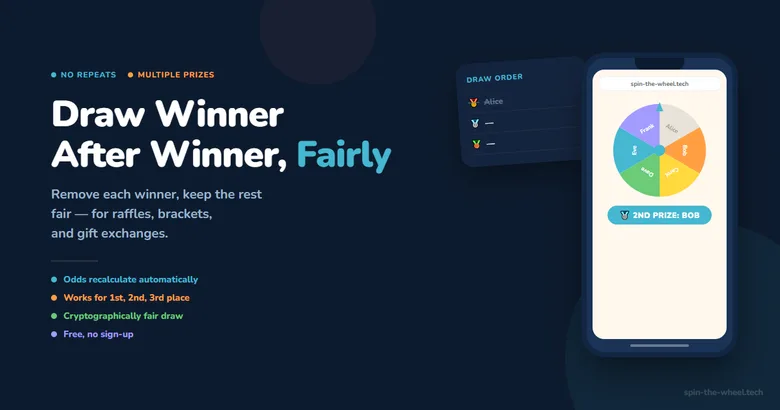
With 6 names in the wheel, each has a 1-in-6 chance, about 16.7%. Tap Remove & Spin Again after the first winner is picked, and the remaining 5 names now share the wheel at 1-in-5 each, 20%. Every removal recalculates the odds for everyone still in the pool.
| Entries remaining | Individual odds |
|---|---|
| 6 | 16.7% |
| 5 | 20.0% |
| 4 | 25.0% |
| 3 | 33.3% |
| 2 | 50.0% |
| 1 | 100% |
How do professional sequential draws handle this?
The same remove-after-each-pick logic runs one of the highest-stakes draws in sports. In the NBA Draft Lottery, 14 numbered balls form 1,000 possible four-ball combinations assigned to teams. One combination is drawn per pick, and that team is locked in (NBA Draft Lottery, Wikipedia, sourced to the league's official rules). If the same team's combination comes up again for a later pick, it's discarded and redrawn. No team can win two picks in one lottery, by design.
FIFA's World Cup draw works the same way in a different format. Teams are drawn one at a time from seeded pots and placed into groups; once a team is drawn, it's removed from its pot and can't be drawn again (FIFA, Final Draw Procedures). Remove & Spin Again automates the exact same pattern for a raffle, a bracket, or a team standup.
When should you reset the list instead of removing?
| Scenario | What to do |
|---|---|
| Raffle with unique prizes (1st, 2nd, 3rd) | Remove each winner before the next draw |
| Raffle with identical, repeatable prizes | Either works; remove if you want to spread prizes across more people |
| Picking who presents first each day | Reset the full list at the start of each new session |
| Classroom cold-calling | Remove within one class period, reset the next |
| Tournament bracket seeding | Remove after each slot is filled, matching NBA/FIFA-style draws above |
Does removing work for a Secret Santa exchange?
Not automatically. A gift exchange needs a derangement, a full assignment where nobody is paired with themselves. Mathematicians have studied exactly this. As group size grows, the probability that a random assignment happens to be a valid derangement converges to about 1-in-e, roughly 36.8% (Wolfram MathWorld, "Derangement"; Crane & Dye, "The Secret Santa Problem Continues," 2017). It gets close to that number by a group of just 4 or 5 people.
Neither source is written for a spin-wheel tool specifically, but the practical fix follows directly from the math: if you draw names one by one and remove each as they're assigned, the very last spin can still land someone on their own name, since by then they may be the only entry left. When that happens, don't accept the result. Reset just that last pairing and redraw it, rather than restarting the whole exchange.
Can you weight repeat draws?
Spin the Wheel gives every entry equal odds and doesn't include a built-in weighting feature. If someone bought three raffle tickets and should have three times the chance, the common workaround is adding their name three times instead of once. Each copy is a separate, equally-weighted entry, so their effective share of the pool goes up without changing how any single spin works.
This mirrors how weighted sampling without replacement is formally defined (Efraimidis & Spirakis, 2006). Each draw's odds are proportional to the remaining entries' share of the total, and the selected entry is removed before the next draw. Adding duplicate names is the practical version of that same idea. One caveat: if that person wins, removing only their winning entry still leaves their other tickets in the pool for the next prize, which is usually exactly what you want.
Frequently asked questions
Does removing a winner really change everyone else's odds?
Yes. With 6 entries, each has a 1-in-6 (16.7%) chance. Remove the winner and the remaining 5 each rise to 1-in-5 (20%). This isn't a UX nicety, it's a real, calculable shift in probability every time you remove a name.
Can I use Remove & Spin Again for a Secret Santa or gift exchange?
Carefully. Gift exchanges need a derangement, an assignment where nobody draws themselves, and naive sequential removal doesn't guarantee one. If the last spin would assign someone to themselves, reset and redraw that step rather than accepting the result.
Should I remove winners in a raffle with multiple identical prizes?
It depends on your rules. If each entrant should win at most one prize, remove every winner. If repeat wins are allowed and you'd rather not exclude anyone, leave the list alone and treat each draw as independent.
Why do professional drawings like the NBA Draft Lottery remove picks as they go?
So no team can win two picks in one lottery. After each pick is assigned, that team's remaining number combinations are discarded and redrawn if selected again, the same principle as tapping Remove & Spin Again after every winner.
Can I give someone better odds without a native weighting feature?
Spin the Wheel gives every entry equal odds and has no built-in weighting. The common workaround is adding a name multiple times, each copy is one more equally-weighted entry, which raises that person's effective share of the pool.
Ready to draw your winners?
Open Spin the Wheel, load your entries, and tap Remove & Spin Again after every winner to keep the rest of the draw fair and free of repeats. For gift exchanges, keep an eye on that last pairing. For everything else, from raffles to tournament seeding, the same rule applies: remove as you go.
Sources
- Tversky, A. & Kahneman, D. "Belief in the Law of Small Numbers." Psychological Bulletin, 76(2), 105-110, 1971. Retrieved 2026-07-04. escholarship.org/content/qt4sw8n41t/qt4sw8n41t.pdf
- Farmer, G.D., Warren, P.A. & Hahn, U. "Who 'Believes' in the Gambler's Fallacy and Why?" Journal of Experimental Psychology: General, 2017. Retrieved 2026-07-04. pmc.ncbi.nlm.nih.gov/articles/PMC5215234
- "NBA draft lottery." Wikipedia, sourced to NBA official rules. Retrieved 2026-07-04. en.wikipedia.org/wiki/NBA_draft_lottery
- FIFA. "Procedures and Pots — Final Draw, FIFA World Cup 2026." Retrieved 2026-07-04. fifa.com/en/tournaments/mens/worldcup/canadamexicousa2026/articles/procedures-pots-final-draw
- Weisstein, Eric W. "Derangement." Wolfram MathWorld. Retrieved 2026-07-04. mathworld.wolfram.com/Derangement.html
- Crane, D. & Dye, T. "The Secret Santa Problem Continues." Rose-Hulman Undergraduate Mathematics Journal, 18(1), Art. 18, 2017. Retrieved 2026-07-04. scholar.rose-hulman.edu/rhumj/vol18/iss1/18
- Efraimidis, P. & Spirakis, P. "Weighted Random Sampling with a Reservoir." Information Processing Letters, 97(5), 181-185, 2006. Retrieved 2026-07-04. utopia.duth.gr/~pefraimi/research/data/2007EncOfAlg.pdf