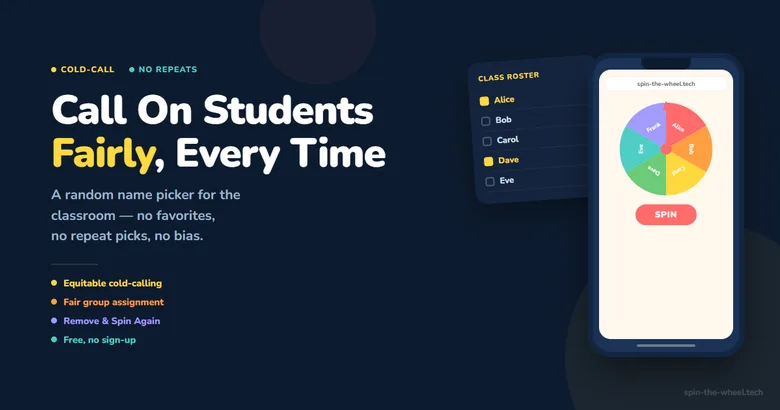
Cold-calling isn't the real problem: who gets called on is
In a 2018 study published in the International Journal of STEM Education, 59.6% of students said cold-calling increased their classroom anxiety, and 0% said it decreased it (Cooper, Downing & Brownell, 2018). That sounds like a case against calling on students at all. It isn't, quite.
The harder problem is a quieter one: teachers don't call on students randomly even when they think they do. A classroom-observation study found boys called out answers roughly 8 times more often than girls (Sadker & Sadker, Failing at Fairness, 1994). Teachers were also more likely to acknowledge the interruption when it came from a boy. Memory and attention play favorites. A random name picker doesn't.
📌 Key Takeaways
- Cold-calling raises anxiety for most students, but voluntary participation grows over a semester in classrooms that use it consistently.
- Teachers unconsciously call on the same students. One study found boys called out 8x more often than girls (Sadker & Sadker, 1994).
- OECD data shows teachers now spend 16% of class time on discipline and management, up from 13% in 2018. Tools that save decision time matter.
- A digital picker can exclude a name for one round and silently re-add it later, something a popsicle-stick jar can't do.
Does random calling actually help, or just cause stress?
Both, and the timing matters. Research published in the Journal of Management Education found voluntary participation was higher in college classrooms with frequent cold-calling than in classrooms without it (Dallimore, Hertenstein & Platt, 2013). Comfort with participating also grew as the semester went on. Students got used to being called on, and started raising their hands more on their own.
The anxiety spike is real, but it's addressable. A 2022 paper in The American Biology Teacher proposes "warm calling" (Metzger & Via, 2022). It means giving advance notice or an opt-out option, a middle ground between pure cold-calling and never calling on anyone. A digital picker can implement that idea directly, which the original "warm calling" research never had a tool in mind for. Show the name, give students a beat before they answer, and let them pass without raising a hand to decline.
Are you actually calling on students at random?
Probably not, and that's not a knock on your teaching. The Sadker research isn't the only data point. A separate economics study estimated that unequal teacher attention slowed the closing of the gender gap in advanced science-track enrollment by roughly 11.7% (Lavy & Sand, 2018). Bias in who gets called on in third grade doesn't stay in third grade. The Sadker classroom-observation data from 1994 and the Lavy & Sand enrollment data from 2018 describe the same mechanism. One catches it in the moment; the other shows it up as an economic outcome two decades later.
A physical randomizer, like a jar of popsicle sticks, only solves half the problem. A digital picker using true cryptographic randomness, the same standard covered in how Spin the Wheel guarantees fair results, removes the memory bias entirely. The tool has no idea who answered last week, who's usually quiet, or who reminds you of yourself at that age.
| Classroom method | Share reporting any anxiety effect |
|---|---|
| Cold call | 59.6% |
| Group work | 69.2% |
| Clickers | 50.0% |
How do you set up a fair random picker for class?
The mechanics take under a minute, whether you're at your desk or walking the room with your phone.
Load your class roster
Type or paste your student list into the entry field, one name per line. It saves for the session, so you're not retyping it every period.
Spin to call on a student
Tap Spin. The wheel lands on a name with the same crypto-grade randomness used for the fairness test, not a pattern you or your students can learn.
Tap Remove & Spin Again
Once a student answers, drop their name so they're excluded from the next draw. Everyone gets a turn before anyone gets a second one.
Reload the full roster next period
Start the next class or the next question set with everyone back in the pool. See the general setup guide for saving multiple class lists.
Pro tip: if a student is having a rough day, quietly remove their name before you spin. No one sees you skip them, unlike visibly setting aside their popsicle stick.
Why is this better than popsicle sticks or equity cups?
Popsicle-stick and equity-cup methods are the analog version of the same idea, and plenty of teachers already trust them. Education researchers caution they still need care (ASCD, Educational Leadership; Edutopia, Safir). Rigid random calling can put English-language learners or students with disabilities on the spot without a graceful way out.
A digital picker keeps the randomness but adds what a jar of sticks structurally can't: a silent exclude list, which is exactly the gap the ASCD and Edutopia caveats above are describing. You can exclude a name for one round without anyone noticing a stick went missing, then re-add it later in the same class. Reset the full list instantly between periods, no re-writing sticks between sections.
Can it handle group work and team assignments too?
Yes, the same tool that removes bias from cold-calling removes it from grouping. Load the roster, spin repeatedly with Remove & Spin Again, and you get randomly assembled teams instead of the same friend clusters every time.
👥 Group assignment
Spin through the full roster once to build balanced groups without anyone picking their friends first.
🔄 Role rotation
Spin for presenter, note-taker, or timekeeper so the same two students don't always end up in charge.
🎤 Presentation order
Nobody wants to go first or last by pure luck of the draw. Let the wheel settle it instead of you.
📋 Participation grading
A visible spin history gives you a defensible record of who was called on, useful if a participation grade is ever questioned.
Does an equitable picker actually change classroom behavior over time?
The clearest evidence is the follow-up to the 2013 cold-calling study. Male and female students participated at more equal rates specifically in classrooms with frequent, consistent cold-calling (Dallimore, Hertenstein & Platt, 2019). Consistency, not any single dramatic gesture, is what closes the gap.
That consistency is also a time problem. OECD's TALIS 2024 survey found teachers now spend 16% of class time on discipline and classroom management, up from 13% in 2018 (OECD, Results from TALIS 2024). In the US, "maintaining classroom discipline" is now the single most commonly cited source of teacher stress, ahead of accountability pressure (OECD, TALIS 2024 United States Country Note, 2025). A tool that picks a name in one tap gives some of that time back.
| Year | Share of class time on discipline & management |
|---|---|
| 2018 | 13% |
| 2024 | 16% |
Frequently asked questions
Does calling on students randomly actually reduce anxiety?
Not exactly. A 2018 study found 59.6% of students reported cold-calling increased their classroom anxiety, with 0% reporting it decreased (Cooper, Downing & Brownell, 2018). But a separate 2013 study found voluntary participation rose over a semester in high-cold-call classrooms, so the anxiety and the long-term benefit can coexist.
How is a digital name picker more fair than a teacher's own judgment?
Human memory and attention are biased even without intent. A classroom-observation study found boys called out roughly 8 times more often than girls, with teachers more likely to acknowledge it (Sadker & Sadker, 1994). A digital picker uses cryptographic randomness, so every name has an equal, verifiable chance.
Can I stop it from picking the same student twice in one class?
Yes. Tap Remove & Spin Again after a student answers, and their name drops out of that round. Reload your full roster before the next class period or the next question set.
Is a random name picker better than popsicle sticks or equity cups?
Education researchers note popsicle-stick methods must be used carefully, since rigid random calling can single out English-language learners or students with disabilities without a quiet way to skip a name (ASCD, Educational Leadership). A digital picker lets you exclude a student from a round without anyone seeing.
Can I use it for group work, not just calling on individuals?
Yes. Load your roster and spin repeatedly with Remove & Spin Again to build randomly balanced groups, assign rotating roles like presenter or note-taker, or set a fair presentation order.
Ready to call on your class fairly?
Open Spin the Wheel, paste in your roster, and spin. The bias a teacher can't fully see in themselves disappears the moment the picking is handled by cryptographic randomness instead of memory. No app, no sign-up, no cost, whether you're running it from the classroom computer or your phone while walking the room.
Sources
- Cooper, K.M., Downing, V.R. & Brownell, S.E. "The influence of active learning practices on student anxiety in large-enrollment college science classrooms." International Journal of STEM Education, 2018. Retrieved 2026-07-04. pmc.ncbi.nlm.nih.gov/articles/PMC6310416
- Sadker, M. & Sadker, D. Failing at Fairness: How America's Schools Cheat Girls, 1994. Retrieved 2026-07-04. books.google.com/books/about/Failing_at_Fairness
- Dallimore, E.J., Hertenstein, J.H. & Platt, M.B. "Impact of Cold-Calling on Student Voluntary Participation." Journal of Management Education, 2013. Retrieved 2026-07-04. journals.sagepub.com/doi/abs/10.1177/1052562912446067
- Dallimore, E.J., Hertenstein, J.H. & Platt, M.B. "Leveling the Playing Field: How Cold-Calling Affects Class Discussion Gender Equity." Journal of Education and Learning, 2019. Retrieved 2026-07-04. eric.ed.gov/?id=EJ1207291
- Metzger, K.J. & Via, E. "Warming Up the Cold Call: Encouraging Classroom Inclusion by Considering Warm- and Cold-Calling Techniques." The American Biology Teacher, 2022. Retrieved 2026-07-04. online.ucpress.edu/abt/article-abstract/84/6/342/189895
- Lavy, V. & Sand, E. "On the Origins of Gender Gaps in Human Capital: Short- and Long-Term Consequences of Teachers' Biases." IZA Journal of Labor Economics, 2018. Retrieved 2026-07-04. ideas.repec.org/a/spr/izalbr/v7y2018i1d10.1186_s40172-018-0069-4
- OECD. "The Demands of Teaching — Results from TALIS 2024." 2025. Retrieved 2026-07-04. oecd.org/en/publications/results-from-talis-2024
- OECD. "Results from TALIS 2024 — Country Note: United States." 2025. Retrieved 2026-07-04. oecd.org/en/publications/results-from-talis-2024-country-notes
- ASCD. "Why Classroom Equity Strategies Aren't Always Equal." Educational Leadership. Retrieved 2026-07-04. ascd.org/el/articles/why-classroom-equity-strategies-arent-always-equal
- Safir, S. "3 Practices to Promote Equity in the Classroom." Edutopia. Retrieved 2026-07-04. edutopia.org/blog/practices-promote-equity-in-classroom-shane-safir