In 2011, researchers studying Israeli parole boards found something strange: judges granted parole in roughly 65% of cases at the start of a session — and almost 0% right before their next food break (Danziger, Levav & Avnaim-Pesso, 2011). The facts of each case didn't change. The judges' capacity to keep making fresh decisions did. If trained professionals run low on decision-making energy over something as serious as parole, it's safe to assume the rest of us are running on empty by the time we get to "what's for dinner."
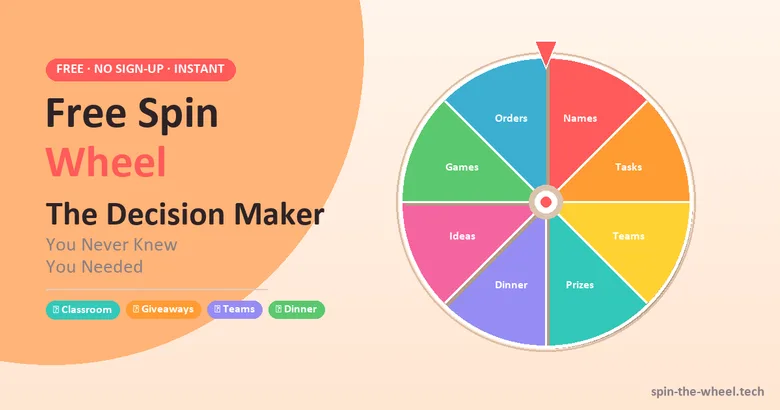
A free spin wheel — also called a picker wheel or decision maker wheel — exists to take the trivial decisions off that pile. Fill it with names or options, give it a spin, and let randomness pick a winner in under three seconds. No back-and-forth, no group chat spiralling for twenty minutes over where to eat. Spin the Wheel does exactly that, for free, in your browser.
What makes it worth using over just going with someone's favorite, or flipping a mental coin, is the same thing that makes the judges study worth reading: humans are worse at treating options equally than they think they are. Here's why that's true — and why the randomness underneath a decision maker wheel matters more than it looks like it should.
What Is a Picker Wheel and How Does It Work?
A picker wheel is a digital randomiser disguised as a carnival game. You type in a list of names, options, or choices, then click spin. The wheel rotates, slows, and lands on a winner — no favouritism, no arguments, no agonising back-and-forth.
Unlike asking people to "pick a number" or drawing names from a hat, a digital spin wheel is:
- Instant — results in under three seconds, no setup time required
- Transparent — everyone can see the wheel land on a result in real time
- Repeatable — spin again immediately if needed, no reset, no reshuffling
- Equal — every entry occupies the same arc, so every option has the same probability of winning
The mechanics are straightforward — the technology underneath is what separates a real decision maker from a toy. Most online wheel spinners lean on JavaScript's built-in Math.random(), which V8 (Chrome's JavaScript engine) implements using an algorithm called xorshift128+. It's fast and statistically well-distributed, but it isn't secret: security researchers have shown the generator's internal state can be algebraically recovered from just a handful of consecutive outputs, after which every future value becomes predictable (Goddard, Independent Security Evaluators, 2018; v8.dev, 2015). For a Friday-night dinner pick that's academic. For a live giveaway with real prizes on the line, it's a real gap between looking random and being random.
Spin the Wheel closes that gap by using crypto.getRandomValues() for every spin instead — the same Web Cryptography API standard behind HTTPS session keys. See Is the Result Fair? for the full breakdown of where that randomness actually comes from, plus the 100,000-spin test results that back it up.
Why Humans Are Bad at Being Random
The straightforward answer to "why use a wheel?" is that humans are genuinely poor at making random selections — even when they're trying.
When a teacher "randomly" calls on students, classroom-observation research has found a real, measurable bias in who actually gets picked — not because teachers mean to play favorites, but because memory and attention aren't neutral (Sadker & Sadker, Failing at Fairness, 1994). When a group votes on a restaurant, the first suggestion mentioned gets a silent head start from a well-documented cognitive bias called anchoring, where an early number or option quietly pulls everyone's judgment toward it (Tversky & Kahneman, Science, 1974). Neither effect requires anyone to be acting in bad faith — it's just how attention and judgment work under normal conditions.
A random picker wheel sidesteps both. It doesn't remember who it picked last, and it doesn't know which option was suggested first.
Four Reasons a Spin Wheel Works Better Than Alternatives
It's truly unbiased
Every entry has an equal probability of landing. No favourites, no patterns, no social pressure influencing the result. The wheel doesn't know who you'd prefer to pick.
It's faster than any alternative
Writing names on slips of paper, shuffling a deck of cards, running a script to generate random numbers — all slower. Configure the wheel once and it's reusable forever.
The visual spin creates buy-in
There's something about watching a wheel slow down and land on a result that feels fair in a way a random number generator doesn't. People accept the outcome because they saw it happen.
It reduces decision fatigue
The judges in the parole study weren't making worse decisions on purpose — they were simply out of decision-making capacity by the end of a session. Trivial choices draw on the same limited resource as important ones. Handing the small stuff to a wheel keeps that capacity in reserve for the decisions that actually deserve it.
Built-In Fairness Verification — See the Proof Yourself
Knowing the tool uses cryptographic randomness is one thing. Being able to verify it is another. Spin the Wheel includes a built-in Auto Spin ×10,000 feature that runs ten thousand simulated spins in under a second — using the same crypto.getRandomValues() function as a real spin — and shows you exactly how many times each entry was selected.
On a five-entry wheel, each option should appear close to 2,000 times. You will notice small differences between entries: one might land 2,011 times, another 1,987. That is not bias. That is exactly what genuine randomness produces over a finite number of trials. A perfectly uniform result at every run would actually be suspicious — it would suggest the numbers were being adjusted to hit a target. The small natural spread you see is the evidence of a fair system, not a flaw in one.
Run this test before any important draw to demonstrate equal distribution to participants before the result is known. Then spin for real. The same cryptographic guarantee applies.
Quick to Start, Powerful When You Need It
Most decision-making tools have a learning curve. Spin the Wheel has deliberately eliminated one. Open the site, type your list, and spin. No tutorials, no onboarding, no configuration before you get your first result. The wheel updates automatically as you type — you can see entries appear on the segments in real time before the first spin.
When you need more, it is there. Remove & Spin Again eliminates a winner from the wheel so you can pick second and third places without the same name winning twice. The Recent Winners log keeps a running history of every result in the current session. The 10,000-spin fairness tester lets you audit the distribution on demand. None of these features get in the way unless you need them — and when you do, they work exactly as expected.
Who Uses It — and For What
🎓 Teachers & classrooms
Load every student's name and spin to call on someone. No favouritism, no awkward silences. Use Remove & Spin Again to work through the whole class without repeats.
🎁 Giveaways & prize draws
Add every entrant's name, share your screen, and spin live. The visual result is more trustworthy than a behind-the-scenes spreadsheet formula.
💼 Teams & standups
Spin to decide who presents first, who owns the next task, or who orders lunch. Turns a minor friction point into a thirty-second moment of fun.
🍕 Group dinners
Eight suggestions, ten opinions, zero agreement. Add them all to the wheel, spin once, and commit. Everyone voted — they just voted by adding their option to the list.
The Classroom Random Name Picker Teachers Swear By
Ask any teacher what they use a picker wheel for and the answer is almost always the same: calling on students fairly. Research on classroom dynamics finds that teachers unconsciously favour engaged students in the front rows — even when they believe they are selecting randomly. A wheel of names removes that bias from the equation entirely.
With Spin the Wheel as a classroom random name picker, every pupil has a mathematically equal chance of being selected. Each name occupies an identical arc segment: with 30 students, each takes exactly 12° of the 360° circle. The crypto.getRandomValues() function picks a landing angle with equal probability across the entire wheel. There is no preference, no pattern, and no way for any student to game the system.
When you want to make sure the same student isn't picked twice, use Remove & Spin Again — their name disappears from the wheel and the next spin starts fresh from the remaining students. The recent winners log keeps track of who has already had their turn. You can also use the wheel for everything beyond name selection: choosing which topic to cover next, deciding which team presents first, assigning project groups, or picking which vocabulary word to review. Students who know anyone could be called next tend to stay more engaged throughout the lesson.
How to Get the Most Out of a Spin Wheel
The tool itself is simple — the impact comes from how you use it. A few habits make a spin wheel feel genuinely authoritative rather than just a novelty:
- Add all options before spinning. If participants can see the complete list before the first spin, there's no question about whether something was quietly added or removed. Set the wheel, show it, then spin.
- Spin in front of your audience. For giveaways and live decisions, share your screen. People trust what they witness. A screenshot of a result is less convincing than a live spin.
- Use Remove & Spin Again for sequential picks. When you need a first, second, and third pick — prize tiers, presentation order, task assignment — remove each winner before spinning again. The same name can't win twice.
- Commit to the result before you spin. The wheel works because everyone agrees in advance that it's the method. If you spin and immediately say "actually, let's go again", you've undermined the whole point.
- Run the 10,000-spin fairness test if anyone doubts it. The built-in fairness tester shows you exactly how many times each option was selected. Equal distribution is the proof.
If you can't decide, the wheel can. Add your options, spin once, and move on — with a result everyone can see and nobody can argue with.
Completely Free — No Account, No Catch
A lot of spinner wheel tools look free until you try to use them. Account required to save your list. Subscription wall before you can access multiple rounds. Watermarked screenshots on the free tier. Upgrade prompts mid-spin. Limits on how many entries you can add without paying.
Spin the Wheel is genuinely, completely free. No account. No download. No subscription. No watermark. No entry limits. No upgrade prompt halfway through your giveaway. Open the site, type your names, and spin. That is the entire flow.
It works on any modern browser on desktop or mobile. The entire application runs in your browser — there is no server processing your entries or logging your results. The spin happens locally, the result appears locally, and the only trace left when you close the tab is your own memory of what was decided. The randomness is free. The fairness test is free. Remove & Spin Again is free. Every feature that makes this tool useful requires nothing beyond a browser and a list of names.
Start Spinning Today
Whether you need a random name picker for your classroom, a decision maker wheel for the dinner debate, or a transparent giveaway tool for your next product launch, Spin the Wheel has you covered — all for free, all in your browser, and all with cryptographically secure randomness built on crypto.getRandomValues() you can verify yourself with a single click.
Open the site, type your list — as few as two options, as many as you need — and hit Spin. No setup, no configuration, no waiting. A decision made fairly, in under three seconds, backed by the same randomness standard that protects your online banking.
Sources
- Danziger, S., Levav, J. & Avnaim-Pesso, L. "Extraneous factors in judicial decisions." Proceedings of the National Academy of Sciences, 2011. Retrieved 2026-08-09. pnas.org/doi/10.1073/pnas.1018033108
- Goddard, D. "XorShift128+ Backward: Recovering Previous States from the Xorshift128+ Algorithm." Independent Security Evaluators, 2018. Retrieved 2026-08-09. blog.securityevaluators.com/xorshift128-backward-ff3365dc0c17
- V8 Team. "There's Math.random(), and then there's Math.random()." v8.dev, 2015. Retrieved 2026-08-09. v8.dev/blog/math-random
- Sadker, M. & Sadker, D. Failing at Fairness: How America's Schools Cheat Girls, 1994. Retrieved 2026-08-09. books.google.com/books/about/Failing_at_Fairness
- Tversky, A. & Kahneman, D. "Judgment under Uncertainty: Heuristics and Biases." Science, 1974. Retrieved 2026-08-09. science.org/doi/10.1126/science.185.4157.1124