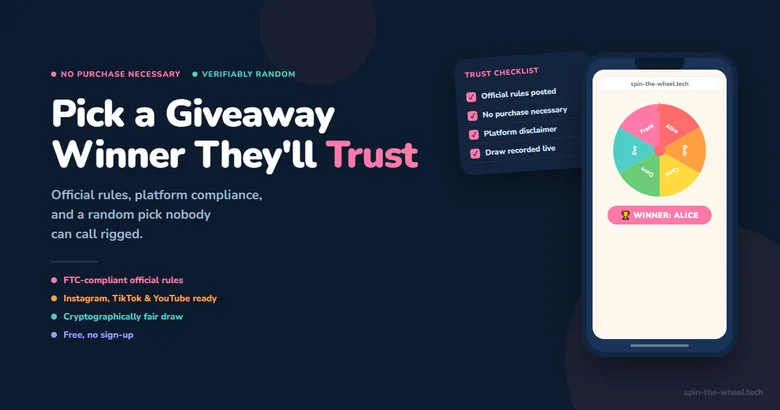
Why does everyone assume your giveaway is rigged?
Trust in influencer content dropped 5 percentage points between 2023 and 2024. Only 74% of consumers now trust or somewhat trust influencer content, versus 87% for general advertising, and 70% feel deceived when they discover an undisclosed partnership (BBB National Programs, 2025 Influencer Trust Index). A giveaway is just one more claim asking to be believed.
That skepticism isn't irrational. Fake giveaways are a known, common scam pattern on every major platform. The rest of this guide covers what it actually takes to run one people will believe: legal compliance, platform rules, clean entries, and a draw you can prove wasn't staged.
📌 Key Takeaways
- Only 74% of consumers trust influencer content at all, down from higher levels in 2023 (BBB, 2025). Assume your entrants start skeptical.
- US giveaways legally need official rules and a free entry option, per FTC guidance on sweepstakes law.
- Instagram, TikTok, and YouTube each add their own disclosure and prize-limit rules on top of federal law.
- A live, screen-recorded draw using verifiable randomness beats any promise that the pick was fair.
How much giveaway fraud is actually out there?
Cybersecurity researchers at Group-IB uncovered a network of at least 60 coordinated scam operations impersonating more than 120 real brands through fake giveaways and surveys (Group-IB). The estimated victim pool is near 10 million people, with potential damage around $80 million a month. Fake giveaways aren't a fringe problem. They're an active, organized scam category.
Bitdefender's threat research found fake giveaways are one of the most common entry points into Instagram's scam ecosystem, and the end goal usually isn't a small shipping fee. It's account takeover, using a fake "claim your prize" login page to steal credentials and two-factor codes (Bitdefender). The FTC separately reports $301 million in consumer losses tied to fake prize, sweepstakes, and lottery scams (FTC Consumer Advice).

Photo via Pexels
This is the real reason a legitimate giveaway has to work harder than a legitimate raffle at a school fair. Entrants can't see your intentions, only a post that looks structurally identical to the scams Group-IB and Bitdefender just described. Compliance and proof aren't red tape here; they're the only signal that separates you from the scam next to you in the feed.
What do your official rules legally need to include?
In the US, a promotion with chance, a prize, and any entry requirement is legally a sweepstakes, and it's illegal to require payment to enter or to improve your odds (FTC Consumer Advice). To stay compliant, most giveaways need a free Alternate Method of Entry (AMOE) alongside any social-action entry route.
A 2024 legal explainer from law firm Baker McKenzie lays out what official rules need to cover (Baker McKenzie, Connect On Tech):
If your total prize pool passes $5,000, New York, Florida, and Rhode Island each require separate state registration and a bond or trust account before you can legally run the promotion (Baker McKenzie). Check that threshold before announcing a big prize.
Do Instagram, TikTok, and YouTube each have their own rules?
Yes, and they stack on top of federal law rather than replacing it. Each platform adds its own disclaimer and prize restrictions, and violating them risks the post itself, not just a legal letter.
| Platform | Key requirement |
|---|---|
| Official rules, full release of Meta from liability, a statement the promotion isn't sponsored by Instagram, and (per the 2025 update) no mandatory engagement action as the sole entry method (Instagram Promotion Guidelines) | |
| TikTok | Entry must be entirely free, prize value capped under $500, no cash or gift cards as prizes, and LIVE giveaways with any purchase incentive need an on-screen disclosure (TikTok Giveaway and Promotions Policy) |
| YouTube | Posted official rules, no requirement to like, share, or subscribe as the only entry method, and a disclaimer the contest isn't sponsored or administered by YouTube |
How do you keep the entry list clean before you draw?
Bitdefender's fraud research flags common bot signals worth screening for before you draw (Bitdefender). Watch for a generic or stock profile photo, little to no original content, repetitive or copy-pasted comments, and an account created recently, right around when your giveaway posted.
Spin the Wheel doesn't scan comments for bot signals. That's a different job, done by comment-picker tools or a manual pass through your entrant list. What it does is guarantee the actual draw, once your list is clean, is genuinely random. Think of it as two separate jobs: filter first, then draw. Don't expect one tool to do both.

Photo via Pexels
How do you prove the winner wasn't picked in advance?
Publish your winner-selection method in the official rules before you draw, not after. Transparency beforehand carries more weight than any explanation afterward, because an after-the-fact explanation is exactly what a rigged giveaway would also say.
Spin the Wheel uses crypto.getRandomValues() for every spin, the same cryptographic standard covered in how Spin the Wheel guarantees fair results. Run the built-in Auto Spin ×10,000 fairness test live, on screen, before the real draw, so your audience sees the distribution is even before the winner is known. Third-party services like RANDOM.ORG's giveaway verification tool offer a similar idea: paste your entries, get a verification code proving the draw wasn't rigged. Spin the Wheel's fairness test is built in and free, so you can demonstrate it live instead of linking to an external code afterward.
Put together, legal compliance, platform compliance, and provable randomness form a three-layer trust stack. Skipping any one layer doesn't just risk a takedown or a fine. It gives a skeptical entrant, the 70% who already feel burned by undisclosed partnerships, a specific reason to assume the worst about this giveaway too.
Is the compliance overhead actually worth it?
In the alcohol industry vertical, posts using #giveaway drove over 1.5 times the engagement of the next best-performing hashtag (Rival IQ, 2025-2026 Social Media Industry Benchmark Report). Giveaway-related hashtags were also among the top engagement drivers across Food & Beverage, Health & Beauty, and Retail. That's a vertical-specific example, not a universal guarantee. But it's a real, sourced number in a space full of unsourced ones.
| Hashtag | Relative engagement |
|---|---|
| #giveaway | 1.5x |
| Next best-performing hashtag | 1.0x (baseline) |
Frequently asked questions
Do I legally need official rules for a small Instagram giveaway?
Yes. In the US, any giveaway with chance, a prize, and an entry requirement is legally a promotion and needs official rules regardless of size (FTC Consumer Advice). At minimum, post the entry method, eligibility, dates, prize value, and how the winner is chosen.
What's an Alternate Method of Entry (AMOE) and why do I need one?
An AMOE is a free way to enter that requires no purchase or engagement action, like mailing an index card. Without one, requiring a purchase, follow, or share to enter can legally turn your giveaway into an unlicensed lottery.
Can I require someone to follow, like, or share to enter?
It depends on the platform and whether you offer a free alternate entry. Instagram's 2025 Promotion Guidelines restrict mandatory engagement actions, and TikTok requires giveaways to be entirely free to enter either way (TikTok).
How do I prove my winner wasn't picked in advance?
Publish your selection method before the draw, then run the pick on camera. Spin the Wheel uses crypto.getRandomValues() and includes a built-in 10,000-spin fairness test you can run live to show the distribution is genuinely random before announcing a winner.
What's the easiest way to filter out fake or duplicate entries before I pick a winner?
Screen entries for bot signals first: generic profile photos, no original posts, repetitive comments, and recently created accounts (Bitdefender). Clean your list, then paste only the verified names into the wheel for the actual draw.
Ready to pick a winner people will believe?
Open Spin the Wheel, paste your cleaned entry list, and run the built-in fairness test live before you draw. Official rules, platform disclaimers, and a random pick nobody can call staged are the whole trust stack, not extra effort tacked onto a giveaway. They're what makes it one.
Sources
- BBB National Programs. "The 2025 Influencer Trust Index." 2025. Retrieved 2026-07-04. bbbprograms.org/media/insights/blog/influencer-trust-index
- Group-IB. "Group-IB uncovers worldwide scam campaign impersonating 120+ brands." 2024-2025. Retrieved 2026-07-04. group-ib.com/media-center/press-releases/target-links-2021
- Bitdefender. "Instagram giveaway scams and how to spot & avoid them." 2025-2026. Retrieved 2026-07-04. bitdefender.com/en-us/blog/hotforsecurity/instagram-giveaway-scams
- Bitdefender. "Instagram scam bots and bot networks explained." 2025-2026. Retrieved 2026-07-04. bitdefender.com/en-us/blog/hotforsecurity/instagram-scam-automation
- FTC. "Fake Prize, Sweepstakes, and Lottery Scams." Consumer Advice. Retrieved 2026-07-04. consumer.ftc.gov/articles/fake-prize-sweepstakes-and-lottery-scams
- Baker McKenzie. "Compliance Essentials for Organizing Legal Giveaways, Sweepstakes, and Contests in the U.S." Connect On Tech, August 14, 2024. Retrieved 2026-07-04. connectontech.bakermckenzie.com/compliance-essentials-for-organizing-legal-giveaways-sweepstakes-and-contests-in-the-u-s
- Instagram Help Center. "Promotion Guidelines." Updated 2025. Retrieved 2026-07-04. help.instagram.com/179379842258600
- TikTok Seller University. "Giveaway and Promotions Policy." Retrieved 2026-07-04. seller-us.tiktok.com/university/essay?knowledge_id=2963741155624705
- RANDOM.ORG. "Multi-Round Giveaways." Retrieved 2026-07-04. giveaways.random.org
- Rival IQ. "2025/2026 Social Media Industry Benchmark Report." Retrieved 2026-07-04. rivaliq.com/blog/social-media-industry-benchmark-report