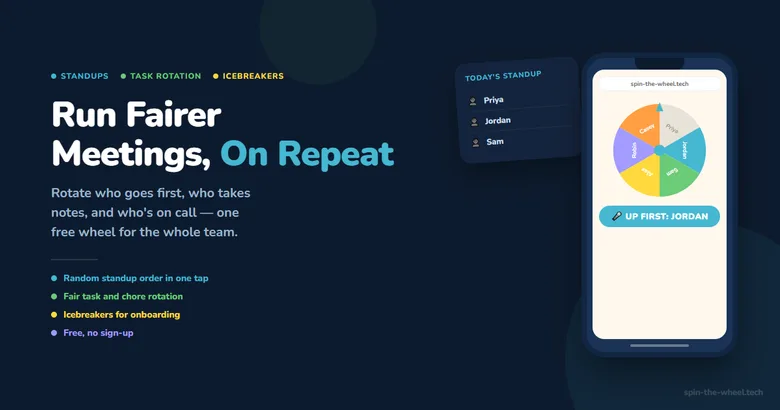
What is a spin wheel for teams, and how do you set one up?
A spin wheel for teams is the same free spinner used for names, loaded instead with your team roster, agenda items, or task list. Type in everyone attending, tap spin, and cryptographically random selection picks who goes first, who presents, or who's on call, removing the "it's always the same person" pattern that creeps into recurring meetings.
None of that friction is really about the meeting itself. Atlassian's workplace survey found employees lose 31 hours a month to meetings they consider unproductive, and 47% named meetings their single biggest office time-waster (Atlassian, "You Waste A Lot of Time at Work"). A lot of that comes down to who talks first, who's stuck taking notes every week, and who never gets picked to lead. A wheel fixes the "who" in about three seconds.
📌 Key Takeaways
- Atlassian's workplace survey found 47% of employees call meetings their #1 office time-waster, and estimate losing 31 hours a month to unproductive ones (Atlassian).
- Microsoft's 2025 Work Trend Index found the most-interrupted employees face a meeting, email, or chat ping every two minutes, roughly 275 times across a day (Microsoft WorkLab, 2025).
- Groups anchor on whoever speaks first; a 2018 study found early speakers gain short-term influence, but later speakers actually carry more weight in the long run (Moussaïd, Campero & Almaatouq, PLOS ONE, 2018).
- Google's two-year Project Aristotle study of 180+ teams found psychological safety, not seniority or skill, was the strongest predictor of team performance (Google re:Work).
- The same wheel that sets standup order also handles task rotation, on-call backup, and icebreakers.
Does randomizing who speaks first actually reduce meeting bias?
Yes, for one specific and well-documented bias. Groups anchor on whichever opinion enters the discussion first, giving it outsized influence over where the conversation lands (Moussaïd, Campero & Almaatouq, PLOS ONE, 2018). Researchers studying small-group decision-making describe this as a form of path-dependence: early speakers shape the frame, and later contributions get evaluated against that frame rather than considered fresh.
Interestingly, the same research found a second effect running the other way: speakers who go later are rated as more persuasive in the long run, once the group has had time to weigh in. Put together, the practical fix isn't "always go last" or "always go first," it's removing the pattern entirely. When the same senior voice opens every planning meeting, that person's framing becomes the unspoken anchor by default. A random speaking order breaks that default without anyone having to enforce it socially.
Tip: For brainstorms specifically, have the wheel pick who shares first, then go around the room in order from there. That way nobody's contribution gets buried by silence while everyone waits to see who volunteers.
How do teams use a wheel for standups and meeting facilitation?
Load the wheel with everyone attending, spin it once at the top of the call, and let the result set standup order for that session. Tap Remove & Spin Again after each person finishes if you want a full no-repeat order rather than a single random starting point.
The same trick covers the roles nobody wants to volunteer for. Rotate the note-taker, the retro facilitator, or the person who books the next planning session, all from one wheel loaded with the team roster. Microsoft's 2025 Work Trend Index found the most-interrupted employees face a ping every two minutes, about 275 across a day (Microsoft WorkLab, 2025), so a facilitation decision that used to eat up 30 seconds of "does anyone want to..." silence at the start of every meeting adds up fast across a calendar that fragmented already.
What other office use cases work well?
Beyond meetings, a team wheel handles anything with a "who's turn is it" answer. Teams that rotate the office coffee run or the shared-inbox triage tend to load the wheel with names, remove the winner, and let the list refill once everyone has had a turn, the same logic as a raffle with no repeat winners.
Daily and weekly rotation
Standup order, note-taker, retro facilitator, and on-call backup all work the same way: spin, remove the winner, and let the pool refill once everyone's had a turn.
One-off team decisions
Team lunch spot, icebreaker prompt for a new hire's first week, and who gets the shoutout in the next all-hands raffle all work as single spins with no removal needed.
| Use case | What to load | Removal? |
|---|---|---|
| Standup speaking order | Everyone attending | Yes, spin again after each turn |
| Note-taker rotation | Full team roster | Yes, remove until everyone's had a turn |
| On-call backup | Eligible on-call engineers | Yes, matches raffle-style fairness |
| Lunch spot picker | Restaurant shortlist | No, single spin |
| Onboarding icebreaker | Prompt list, not names | No, single spin |
Google's Project Aristotle, a two-year study spanning 180-plus teams and over 200 interviews, found that psychological safety, not seniority, tenure, or individual skill, was the strongest predictor of team performance (Google re:Work, "Understand team effectiveness"). Low-stakes icebreakers and visibly fair rotation both feed that same sense of safety: nobody has to wonder whether the note-taker slot always lands on the newest hire, because the wheel decided, not a manager's habit.
Frequently asked questions
What should we load into the wheel for a daily standup?
Just the names of everyone attending. Spin once at the start of the meeting to set speaking order, so the same one or two people don't default to going first every day. Remove each name after they've spoken if you want a guaranteed no-repeat order for that session.
Can the wheel rotate who takes meeting notes fairly?
Yes. Load the team roster, spin before the meeting starts, and whoever it lands on takes notes that session. Keep a running list of who's already had a turn and remove their name from the wheel until everyone else has rotated through.
Does randomizing speaking order really reduce bias in brainstorms?
It addresses one specific bias: groups anchor on whoever speaks first, giving early opinions outsized short-term weight (Moussaïd, Campero & Almaatouq, PLOS ONE, 2018). Randomizing order doesn't remove all bias from a discussion, but it stops the same senior voice from setting the anchor every single time.
How do we use it for on-call or task rotation without repeats?
Load everyone's name, spin, and remove the winner before the next spin, the same Remove & Spin Again mechanic used for raffles. Each removal recalculates the odds for whoever's left, so a team of 6 starts at a 16.7% chance each and rises as names are removed.
What's a good icebreaker to pair with a team spin wheel?
Load a second wheel with prompts like "favorite team lunch spot" or "a skill you want to learn this year" and spin it right after the standup-order wheel. Keep prompts about preferences and goals, not personal disclosures, especially for teams that still include new hires.
Ready to run a fairer standup?
Open Spin the Wheel, load your team roster, and let one tap set the order, the note-taker, or the on-call backup. Swap in a prompt list for onboarding icebreakers, or a restaurant shortlist for the next team lunch. Same free wheel, every recurring "whose turn is it" question in the office.
Sources
- Atlassian. "You Waste A Lot of Time at Work" infographic. Retrieved 2026-07-18. atlassian.com/time-wasting-at-work-infographic
- Microsoft WorkLab. "Breaking Down the Infinite Workday" (2025 Work Trend Index special report). Retrieved 2026-07-18. microsoft.com/en-us/worklab/work-trend-index/breaking-down-infinite-workday
- Moussaïd, M., Campero, A.N. & Almaatouq, A. "Dynamical Networks of Influence in Small Group Discussions." PLOS ONE, 13(1), e0190541, 2018. Retrieved 2026-07-18. pmc.ncbi.nlm.nih.gov/articles/PMC5770023
- Google re:Work. "Guide: Understand team effectiveness" (Project Aristotle). Retrieved 2026-07-18. rework.withgoogle.com/intl/en/guides/understand-team-effectiveness